

For many years, we saw the same sentence when we installed Java: “Java runs on three billion devices.” Today the number is much bigger. Java is everywhere: in bank servers, in Android phones, in smart cards, in industrial systems. But the company that gave this language to the world is gone. It disappeared in 2010. Sun Microsystems was a giant. It built the base of enterprise computing, it shaped the infrastructure of the internet, and it trained some of the best people in Silicon Valley. Then it left the stage quietly.
The Beginning
The story starts at Stanford in 1982. A PhD student called Andy Bechtolsheim designed a workstation for the university’s network project. He gave it the name of the project: Stanford University Network, or SUN for short. He got the idea from the Alto computer at Xerox PARC. At that time, computers were expensive and closed. This machine was different: it was cheap, it was open, and, most importantly, it was connected to a network. Later, two other Stanford graduates joined Bechtolsheim: Vinod Khosla and Scott McNealy. Soon after, Bill Joy came too. He was from Berkeley, and people call him the father of BSD Unix. The four founders had one idea: mainframes were big and slow, so they wanted to bring the power to the desktop.
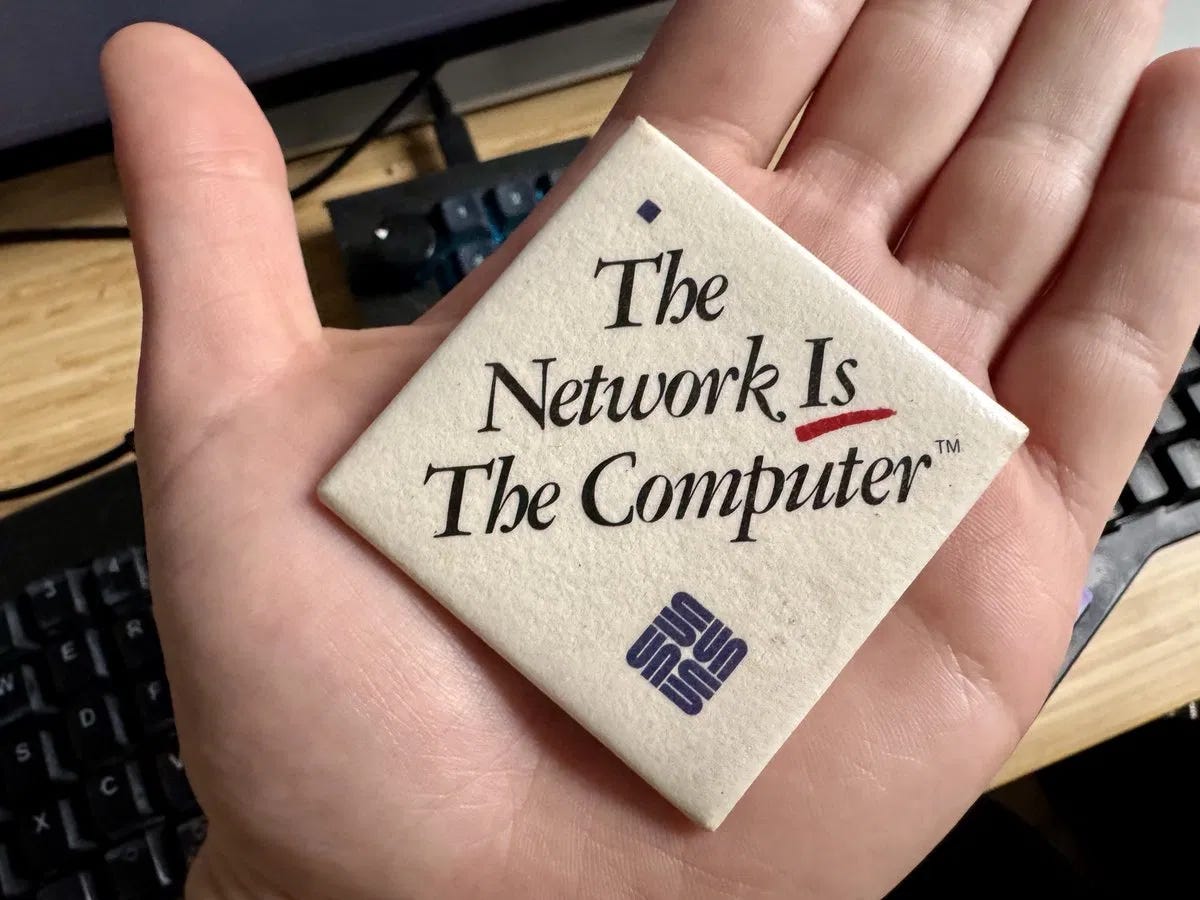
They put their philosophy in one sentence. John Gage, a researcher at the company, said it first: “The network is the computer.” In the middle of the 1980s, personal computers were like separate islands. So this idea sounded too brave. But Sun put this belief inside its products. It built network communication into the operating system, it made the machines talk to each other, and it built everything on this connection.
The Rise
The rise was very fast. Sun went public in 1986. In 1988, it reached one billion dollars in revenue. No computer company in history had done this so quickly. The dotcom bubble was the golden age for Sun. Every new internet company used Sun servers in its data centre. The company turned this into an advertisement: “We put the dot in dot-com.” It was even proud of its stock symbol, which was JAVA. Sun was also a talent factory. Eric Schmidt, who later became the head of Google, was the chief technology officer of the company. Many people who shaped the future of Silicon Valley worked at Sun.
Then the bubble broke. In the early 2000s, internet companies failed one after another. Sun’s biggest group of customers disappeared very fast. Server revenue fell. But the real problem came from another place. Servers with Linux became cheap. Sun’s expensive SPARC processor and Solaris operating system could not compete with them. Companies did not want special workstations for thousands of dollars any more. They preferred open source software on normal hardware. For years, McNealy did not take this seriously. He thought Linux and Intel processors were low quality, and he believed enterprise customers would refuse them one day. This wrong idea stopped Sun from moving to cheaper hardware for many years.
Here is the saddest part. Sun created one of the most valuable pieces of software in the world, but it never learned how to make money from it. Java went everywhere. Sun gave it away almost for free, and almost no money came back to the company. Its competitors had lower profits from hardware, so they made money from services and consulting. But Sun gave its best things away for free. Sun also bought other companies, like StorageTek (2005, about four billion dollars) and MySQL (2008, one billion dollars). But this did not close the wound.
The Last Act
The last act started in the spring of 2009. First, Sun talked with IBM about a sale, but the two sides did not agree on the price. Then Oracle came. Larry Ellison agreed to buy Sun for 9.50 dollars per share, or 7.4 billion dollars in total. The European Commission was worried about MySQL, so the review took months. The deal finished on 27 January 2010. The company that once kept the internet alive was no longer independent. Java and Solaris went to Oracle, the database giant.
So what is left? The list is long. Sun built its own processor architecture, SPARC. Its operating system, first SunOS and then Solaris, ran serious workloads in universities, in finance and in many other places. NFS, the network file system, made it normal for different computers to share files. ZFS is the grandfather of modern storage systems. And in 1995, the language that changed the world arrived: Java, with the promise “write once, run anywhere.” It became the common language of the internet age.
Some of these things died with the company. Some are still here. Java still runs on billions of devices. NFS and ZFS are the quiet heroes of today’s infrastructure. Sun believed in open standards and open source, and today this is the normal way of the software world. But its biggest legacy is not a product. It is an idea: the network is the computer. In the cloud age, our applications, our data and our computing power are not on the computer on our desk. They are at the other end of the network.
The Tragedy
This is exactly where Sun’s tragedy is. The company was right, but it was right too early. When it said “the network is the computer,” there was no internet connection fast enough for this vision, and there was no economy to support it. Today we live in a world built on AWS, Azure and Google Cloud. So all of us live inside the dream that Sun had in 1984. And here is the bitter irony: the cloud made this dream real, but the cloud grew on Linux and cheap servers, the same things that McNealy thought were low quality. So the forces that killed Sun were also the forces that proved it was right. The company died, but its idea won. Java still runs everywhere, the network really became the computer, and a generation of Sun people built the next giants of Silicon Valley.
And maybe the same story is happening again right now. The companies that started the age of artificial intelligence see the future before everybody else, just like Sun. And they burn billions of dollars to build it. But history reminds us of one thing again and again: the first company to imagine a technology is often not the company that makes money from it. Some of the companies that look very bright today may also leave the stage quietly. Maybe this is the saddest fate for a technology company: you see the future before everyone else, and you are right, but you do not live long enough to see it.