

For months I have written about artificial intelligence. This week I wanted to take a small break. We always talk about today and tomorrow. I thought it would be good to look back at the roots of these things. And almost all of those roots grew in one place. This is surprising, but it is true.
You are reading these lines on a device. There is a chip inside it. Its operating system has a “father”. There is a mathematical idea that connects your device to the network. There is a theory that separates the signal from the noise. All of them came from the same place. Maybe you first thought of Silicon Valley. But no. It was one research laboratory, and the money of a monopoly paid for it: Bell Labs.
Patient Money
AT&T started Bell Labs in 1925 as its research department. The budget was big, but that was not the only special thing. AT&T was a monopoly. Its income was very stable. So the company could pay for research for many years, sometimes for decades. It did not need fast results.
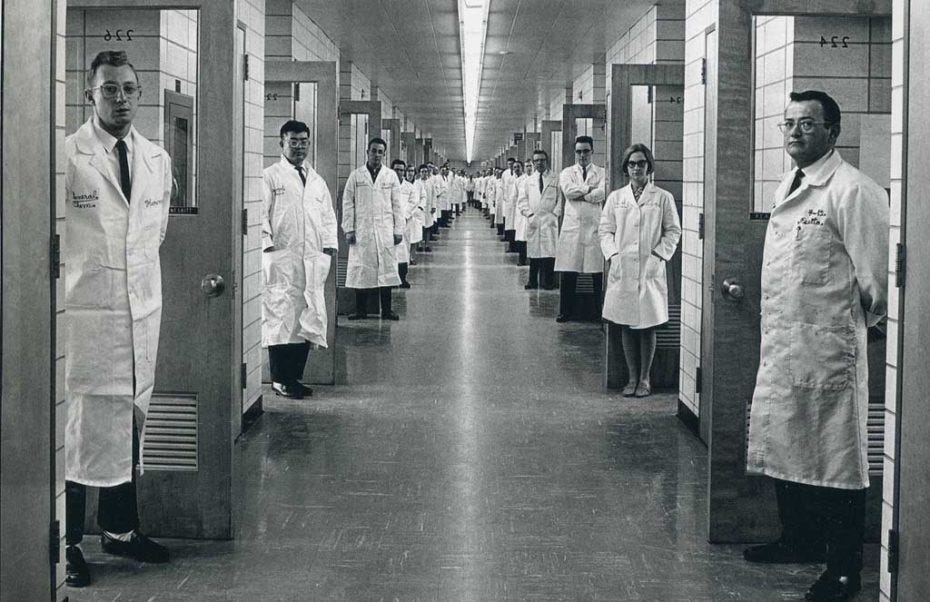
The manager Mervin Kelly built a simple but radical model. Bring the best physicists, mathematicians and engineers into one building. Do not give them hard deadlines. Let people from different fields talk to each other every day. Even the main building in Murray Hill had this idea inside it. The corridors were very long. So a researcher had to leave the room and meet people from other fields.
Maybe the most interesting part of this culture was this: you were allowed to fail. A researcher could work for years and find nothing. That was not a reason to lose the job. This freedom was not a luxury. It was the model itself. Really new things never fit into a calendar. A mathematician had lunch with a chemist or an engineer. Often this was more useful than a line in the budget. Knowledge did not come from the boss. It came from discussion.
From the Transistor to Unix
The result was an amazing series of inventions. In 1947 John Bardeen, Walter Brattain and William Shockley invented the transistor. Today it is the base of every computer, every phone and every data centre. One year later, Claude Shannon published his famous paper. It created information theory, and it gave the world the word “bit”. He was the first person to explain one problem with mathematics: how can we send a message through a noisy channel without mistakes? Every message you send and every video you watch use this theory.
At the end of the 1960s, Ken Thompson and Dennis Ritchie made the Unix operating system and the C programming language. Linux, macOS, Android and almost all cloud systems come from Unix. I must also add more things to the list: the laser, the solar cell, the CCD image sensor, communication satellites and the idea of the mobile phone.
Who Paid the Bill?
These are not big marketing words. Bell Labs is a research laboratory with 10 Nobel Prizes. It made much more value than the company itself needed.
Here we should also look at who owned the company. The money for Bell Labs did not come from a few rich bosses. AT&T was a public company, and many people owned small parts of it. Millions of small investors trusted it. But why did they accept research instead of more profit? After the Communications Act of 1934, the government fixed the profit rate of the company. If the company earned too much, the regulator made telephone prices lower. So extra money did not go to the shareholders. It went to cheaper phone bills. In other words, telephone customers paid for basic science, and this was built into the system.
In the whole Bell System, research and development was only two or three per cent of the income. But this small part flowed for decades, without stopping and without questions. A company can be open to the public. It can follow strict rules. And it can get some special rights in return. Maybe this is the best example of what such a company can give to society.
Why Did the Engine Stop?
So why did this amazing engine stop? The answer is inside the same story. In 1984 the United States broke the AT&T monopoly. When the monopoly ended, the patient money ended too. Competition gave people cheap telephones. But it also removed the company that paid for this important research.
In 1996 Bell Labs went to Lucent. In 2006 it went to Alcatel-Lucent. Since 2016 it has belonged to Nokia. Nokia Bell Labs still does valuable work today. But the old model is gone: big, patient, and never asking for the result first.
Why is it so difficult to build something similar today? Because Bell Labs was the product of a social agreement. Society accepted the monopoly, and the monopoly gave this comfort to science. That agreement does not exist anymore. Modern technology giants also have strong research labs. But most of them work for the next product, the next quarter, or the share price. Think about a question with an answer in twenty years. How many companies will pay for it patiently today?
What If It Never Existed?
What if Bell Labs never existed? I can say this honestly: someone else would find the transistor and information theory, sooner or later. Science never depends on only one institution. But the point is not the single inventions. The real point is the model that could make them, one after another.
Today we see a lot of excitement in the AI race. Most of it is the harvest of seeds from decades ago. The institution that planted those seeds had no pressure for quick money. It could look for answers for years, and maybe those answers would never come. I think our biggest loss is not those inventions. It is that laboratory itself. We have forgotten how to build it.
If you want to read more, I can suggest a few books. The first one I used for this article is Jon Gertner’s The Idea Factory: Bell Labs and the Great Age of American Innovation. It is the most complete history of Bell Labs. It tells the story of Kelly, Shockley and Shannon, and it also explains how the institution worked inside. If you are interested in information theory and the word “bit”, read James Gleick’s The Information: A History, a Theory, a Flood. It puts Shannon’s work into a much bigger historical picture. And if you want to see the general picture of the digital age, read Walter Isaacson’s The Innovators. It goes from Ada Lovelace to today, and Bell Labs has an important place in it.