

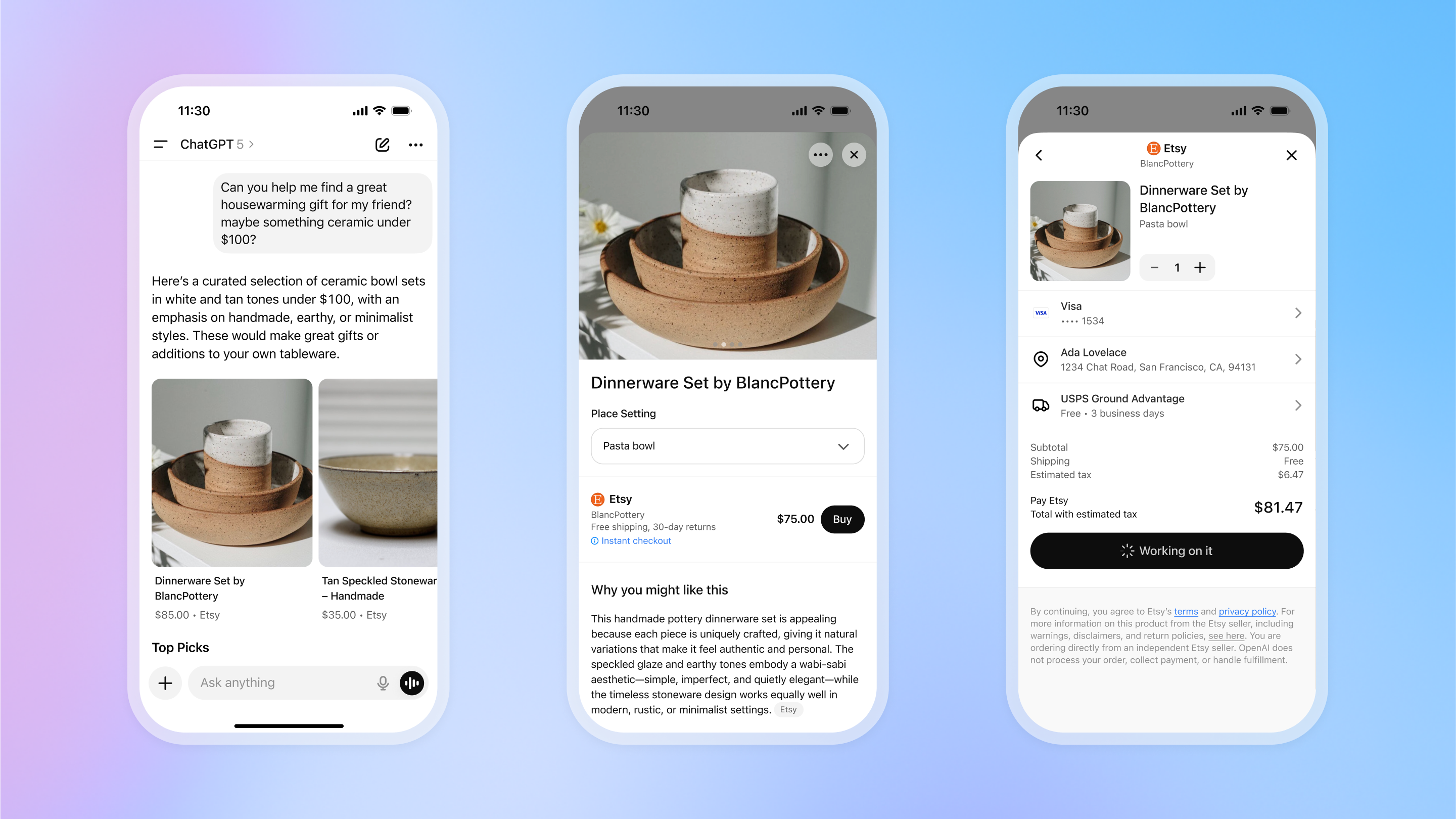
With the joint announcement from Stripe and OpenAI, we’ve learned that ChatGPT will now allow purchases to be completed directly within the platform. Starting with Etsy sellers and soon expanding to over a million Shopify stores, Instant Checkout compresses the “search–website–cart–payment” chain into a single confirmation screen.

You’ve probably seen countless articles about this already. But I want to look at it from a different angle. The psychology of shopping has never been just about meeting a need. Customers feel satisfaction not only from owning the product but from the process of choosing it—browsing options, comparing prices, and reading reviews. That sense of control has always been part of the pleasure of consumption.
Now, with the Agentic Commerce Protocol (ACP), the user asks for a product in chat, the agent recommends the most suitable one, and the payment is completed on the same screen via Stripe. We’re looking at a much faster shopping flow.
But does this speed amplify satisfaction—or leave behind an emptiness that convenience alone can’t fill?
The Pleasure of Choice Is Fading
Behavioral economics suggests that consumers derive satisfaction not only from owning the product but also from the entire process of selecting it. Browsing catalogs, comparing prices, reading reviews—all of these create pleasure independent of the product itself. E-commerce has long relied on this dynamic, giving shoppers a sense of control.
ACP rewrites that system entirely. When someone asks ChatGPT for “$100 running shoes,” the system scans thousands of options, lists the best fits, and directs the user directly to a single buy button.
Products from Etsy or Shopify can now be purchased within seconds, inside a chat window. The process is faster—but the consumer is barely part of it.
When Choice Shrinks, Does Satisfaction Shrink Too?
This creates an interesting paradox. Barry Schwartz once argued that too much choice overwhelms and frustrates consumers. Agentic commerce seems to solve that problem. It filters the overload and presents the optimal option. The consumer no longer feels indecisive, but also no longer feels like the one making the decision.
For brands, that’s a much deeper loss. Loyalty has long been built on the bond formed during the customer’s own decision-making process. Choosing one brand over another made ownership more personal. ACP threatens that connection. When the agent decides, the consumer remembers the system’s recommendation, not the brand itself. In other words, the emotional infrastructure of brand loyalty stops working.
At first glance, this seems like progress—faster, smoother, simpler. But in the long run, shopping may lose its emotional core. The consumer might buy the product, yet silently wonder: Who actually made the choice?
How Can Brands Respond to the Agent?
For brands, the challenge is twofold: getting recommended by the agent and then building emotional ties afterward. What can they do?
Reintroduce a sense of control at the delivery stage, offer options for packaging style, delivery date, or complementary products.
Turn purchases into membership experiences, invite customers into exclusive groups, clubs, or communities around the brand.
Follow up post-purchase through email or SMS to encourage repeat buying and strengthen recall.
If ACP succeeds as intended, brands will need these post-agent touchpoints to rebuild connection and loyalty.
Can OpenAI Succeed Where Google and Meta Failed?
In-platform shopping isn’t new. Google tried it with Buy on Google to keep users within search results during checkout. Meta attempted the same with Instagram Checkout, uniting discovery and payment. Both failed to achieve meaningful traction.
Users liked the convenience but didn’t want to abandon the trust and experience of the merchant’s own site. Sellers, meanwhile, lost access to valuable customer data, loyalty programs, and post-sale relationships, all locked within the platform. Eventually, both companies backed off.
OpenAI is now taking another shot. The difference lies in design: OpenAI is positioning ACP not as a platform feature but as an open protocol, built in collaboration with Stripe, and supposedly keeping brands at the center of the transaction. Whether it can truly do that remains to be seen.
My take: if ACP only delivers speed, it might share Google and Meta’s fate. But if the agent can combine speed with satisfaction and brand experience, it could redefine how we buy and how we feel about buying.