

The severity and frequency of forest fires have increased significantly in recent years, posing serious threats to the environment and ecosystem. For the last 6 years I have been living in Izmir/Türkiye, and since yesterday, wildfires has been the only agenda here. After an experience in 2020 when a fire broke out within 200 meters of our house and we were kept ready for evacuation, I spent the day yesterday by following the fire that broke out at different points and responding to the calls and messages of friends and family who were worried about me. I tried to use social media limited to avoid seeing posts with dramatic music in the background. After a very romanticized post titled "Flames lit up the night in Izmir", I stopped following any source other than local ones I trust.
Today, while I was scanning the highlighted headlines for tech, because of the ongoing fire, my mind came up with the question: "How is AI being used globally to prevent or control these fires faster?". I say globally, because in our country, where the agenda changes very quickly after major disasters, the issue of measures taken until the next disaster is quickly closed. While researching the topic, I discovered AI models that can detect fires faster and map their spread with simulatiions.
The Google Research team is using AI to identify the boundaries of large wildfires and provide this information to affected communities and fire authorities through Google Search and Maps. Machine learning analyzes satellite imagery and sends push notifications to nearby users with fire information.
FireBench is a dataset with simulations covering 117 different combinations of wind speed and slope. This dataset makes it possible to investigate fire spread behavior and again supports the development of a machine learning model.
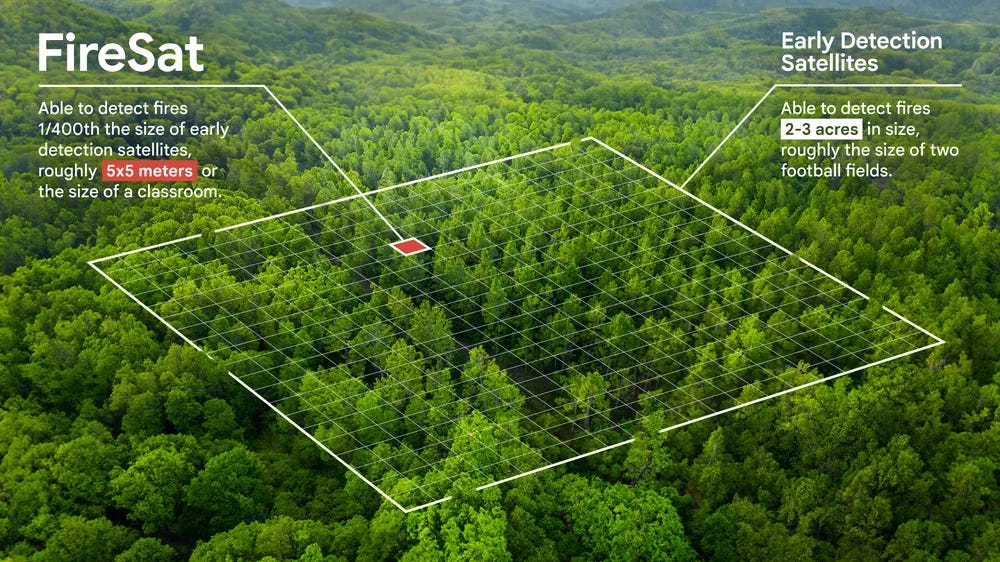
FireSat is a constellation of satellites being developed to overcome the challenges posed by the low resolution of satellite imagery currently used for active firefighting, or updated only a few times a day. The first prototype was launched in March 2025 and, once operational, will provide high-resolution images every 20 minutes. AI will compare the current image with previous thousand images of the same spot to determine the presence of a fire and issue a fire warning, taking local weather also into account.
Projects such as “Umgrauemeio” in Brazil, which uses an AI-powered platform called “Pantera”, and “Wildfire Solution”, a thermal intelligence project by “OroraTech” in Germany, aim to shorten the time before the first response to a fire by sending alerts in just three minutes after data analysis. The Pantera software has achieved an 85% reduction in burned areas and 70% savings in operational costs (huge percentages).
In 2021, after the fires that affected the Aegean and Mediterranean regions, the "FireAId" project, pioneered by Koç Holding, was adopted by the Ministry of Agriculture and Forestry, as it was able to detect the risk of forest fires with an accuracy rate of 86%, allowing it to direct its resources from the surrounding areas to high-risk areas before the fire broke out. I am happy to discover a project from our country.
It is very pleasing that technological innovation is also developing in business models that prioritize people and the planet. The fact that AI can be the savior of nature, which is being destroyed by human hands, gives me some hope. Perhaps artificial intelligence technologies can revolutionize firefighting.