

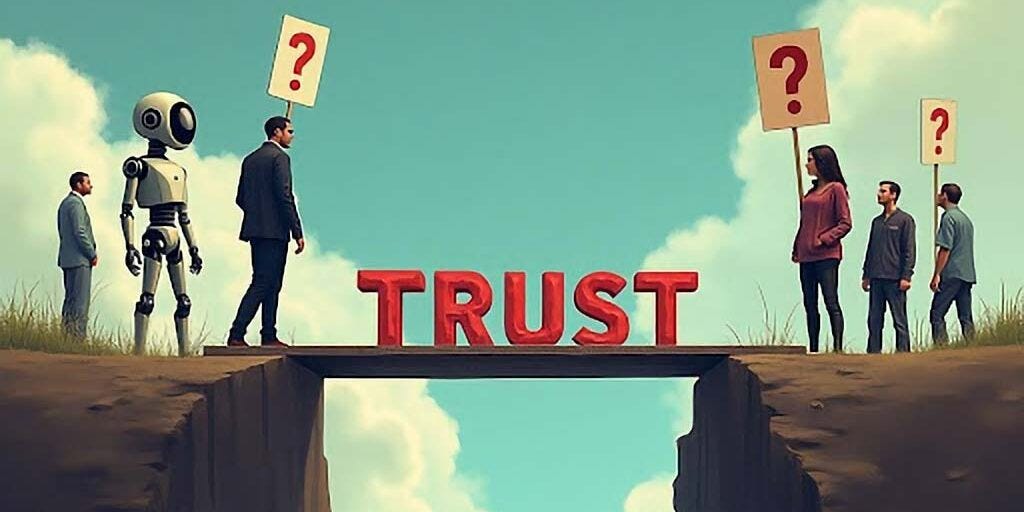
Trusting AI too much brings serious risks, even though technology offers many benefits. While people generally don't trust AI very much, we can see that dependency is increasing. Users don't tend to question whether AI-generated content is correct and reliable. This creates a contradiction called the "AI Trust Gap.”
The Results of Too Much Trust
We heard an interesting example of the risks from trusting AI too much a few days ago. An influencer couple missed their flights after trusting ChatGPT for visa information while planning their trip to Puerto Rico. The AI chatbot gave them wrong information, saying Spanish citizens didn't need a visa. However, they needed to get an ESTA (Electronic System for Travel Authorization) instead of a visa. Mery Caldass says she usually does a lot of research, but this time she asked ChatGPT and it said no visa was needed. This event was a direct result of the couple trusting AI completely without checking information from official government websites.
Why We Shouldn't Trust AI Blindly
Large Language Models (LLMs), which are the foundation of AI tools, get updated according to training cycles that companies decide. The training process usually takes months because it's a long and expensive process involving billions of parameters. When new versions come out, the model has learned information up to the point where its training data was cut off. This is why LLMs might have incomplete information about current events or the latest technologies after their publication date. This gap is partly filled with integrations added after training (like web searching). Therefore, LLMs work like a large knowledge database trained up to a certain date range, not like a daily news source. ChatGPT, Claude, and Gemini that we use in daily life work this way. If there are no features like web searching, the model you're using has information from several months or longer ago.
Also, since there isn't complete transparency about how LLMs are trained, we don't have exact knowledge about the source, freshness, and accuracy of the data used. Training usually uses texts, books, articles, and code pieces collected from the internet. However, some of this data might contain errors, be written with bias, or have one-sided viewpoints. For this reason, instead of accepting every piece of information produced by models as absolutely true, we need to evaluate it with a critical eye. LLMs are powerful helpers, but they're not reliable information sources by themselves - they're starting points that need verification and additional research.
Dangers in Summaries
According to research by Exploding Topics, 42.1% of web users have encountered false or misleading content in AI summaries. Among these errors are "missing important context" (35.82%) and "biased or one-sided answers" (31.5%). Even worse, 16.78% said they received unsafe or harmful advice from AI summaries, which is very critical.
Decreasing Tendency to Verify
People experience these problems and approach them with doubt. However, more than 40% of all age groups rarely or never click on source materials in AI summaries. Only 7.71% said they always click on links. This contradiction comes from users preferring convenience over reliability.
Does It Make Our Work Easier or Make Us Lazy?
KPMG's global study also showed that students show excessive dependency in AI use. More than three-quarters of students (77%) felt they couldn't complete their homework without AI help, and 81% said they put less effort into their classes or homework knowing they could rely on AI. This situation carries the risk of critical thinking and basic skills becoming dull.
AI Literacy
Although AI tools are widely used, AI literacy is limited. About half of participants (48%) said they had limited knowledge about AI. This knowledge gap not only limits users' ability to fully understand AI's capabilities, but also restricts their abilities to critically evaluate AI systems' limitations and outputs, and their skills to protect themselves from harm.
Conclusion
In conclusion, while the conveniences and benefits that AI offers cannot be argued, serious risks exist from trusting it too much, especially the lack of proper information verification. Concrete examples like the influencer couple's experience highlight the vital importance of always evaluating AI answers with a critical eye and verifying information from multiple reliable sources, especially when making important decisions. Increasing AI literacy for all of society is the most important step. Leaving the solution to companies' mercy could be a big mistake.
So, how much do you trust AI? What was the strangest event you witnessed?
See you in the next article.