

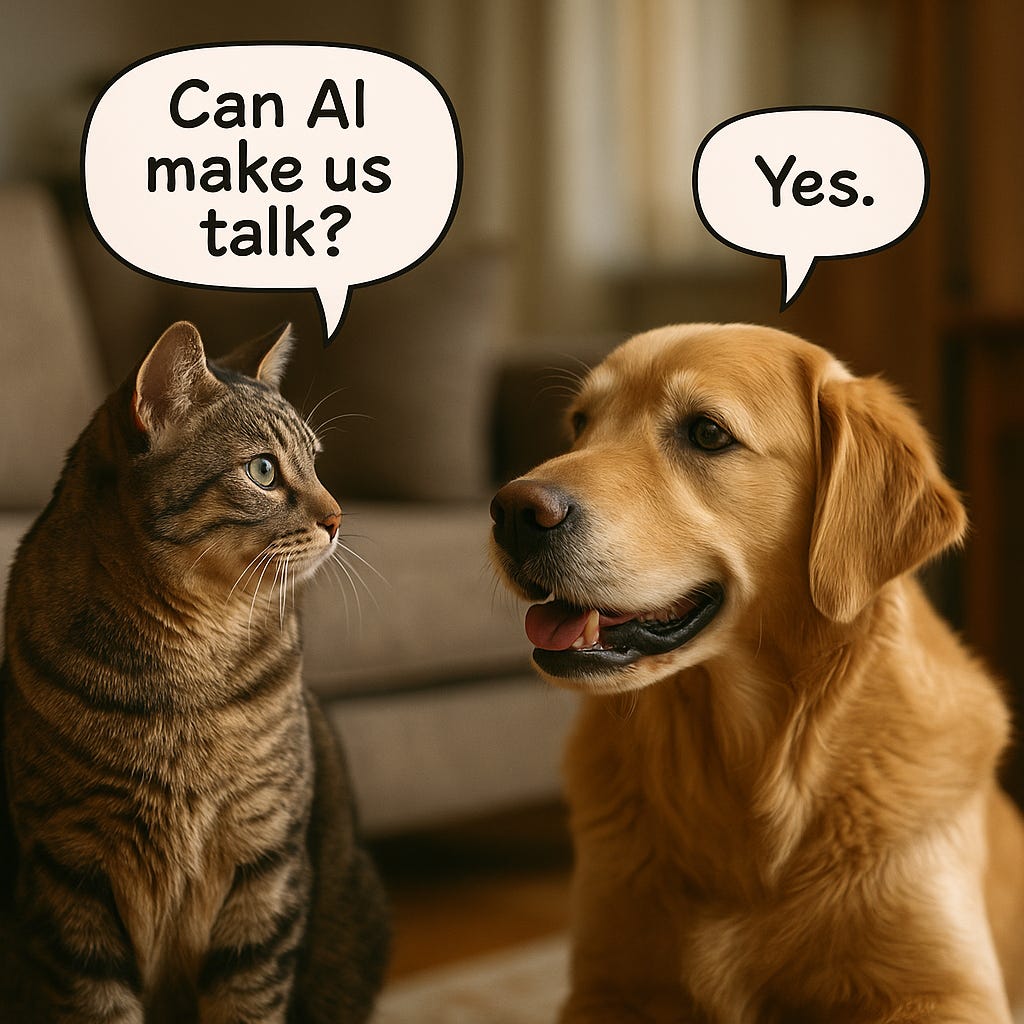
The new technology developed by Baidu, for which Baidu has applied for a patent, redefines non-human communication.
China-based technology company Baidu has announced that it has developed an artificial intelligence model that can translate animal sounds into human language. Although the patent application was filed in December, it caused a stir when it was made public last Tuesday by China's National Intellectual Property Administration. According to the published application, the translation method works by collecting various types of data from the animal, such as "voice, body language, behavioral changes and other biological signs." By analyzing this data, the system first determines the animal's "emotion" and then translates it into the target language.
Of course, this is not the first application to try to interpret sound patterns in context. In 2001, Japanese toy manufacturer Takara made headlines with the launch of Bowlingual, which translates dog barks; the product was named one of the "Best Inventions of 2002" by Time magazine. The company later developed a similar product for cats called Meowlingual.
In 2014, a small Scandinavian research lab raised more than US$22,000 on a crowdfunding platform for a device called “No More Woof”. But the team announced three years later that the project had become “too costly to sustain".
The Earth Species Project, a California-based nonprofit organization, is trying to develop an artificial intelligence system that can translate bird songs, dolphin whistles and elephant grunts. NatureLM, a nonprofit project, announced a $17 million grant to develop language models that can detect how animals communicate with each other.
Researchers are also trying to use machine learning techniques to make sense of the vocalizations of crows and monkeys.
What will change when we know what they are saying?
Emotions are a universal form of communication. This technology could enable deeper emotional communication and understanding between animals and humans, improving the accuracy and efficiency of interspecies communication.
It can be used in many fields, from veterinary medicine to pet technologies, from farm management to wildlife conservation.
But on the other hand, this development also has the potential to make not only inter-human but also inter-species communication possible with artificial intelligence.
Last year, a group of scientists from the Search for Extraterrestrial Intelligence (SETI) claimed to have "communicated" with a humpback whale in Alaska .
Josie Hubbard, a SETI researcher and expert on animal behavior at the University of California, Davis, said in an interview with the New York Post at the time, "The things we learned from communicating with whales could help us one day when we need to connect with aliens."
As you can see, AI making animals "talk" is not only an engineering achievement, but also a philosophical and sociological step that pushes the limits of the ability to "understand". Although we will observe the acceleration of the development of AI products and start-ups for pet owners such as pet-tech, pet-health, etc., if your dog's bark is translated as "don't leave me", will you be able to leave him and leave the house? Or do you think we can use these tools to communicate with other species?
If you don't want to miss such developments:

See you in the next newsletter!