

One of the striking scenarios that makes us think about the future of humanity is on the agenda. I read the article titled "Tech Workers Prepping for AI Apocalypse" breathlessly. I was shocked by the radical measures taken by tech workers preparing for possible disaster scenarios of AI development. Not many years ago, when the Walking Dead series was popular, we read stories of people taking similar precautions against the zombie apocalypse.
I was reminded of Nikki Erlick's The Measure book, which I recently read. The book begins with boxes being left on people's doorsteps all over the world, with the length of the string inside equal to the length of their remaining life. On the one hand, there are people whose future is completely uncertain, living with the threat of a potential apocalypse, and on the other hand, there are characters who either find out their remaining lifespan or refuse to find out without ever opening the box. I wanted to compare the similarities in these two different situations of "facing fate".
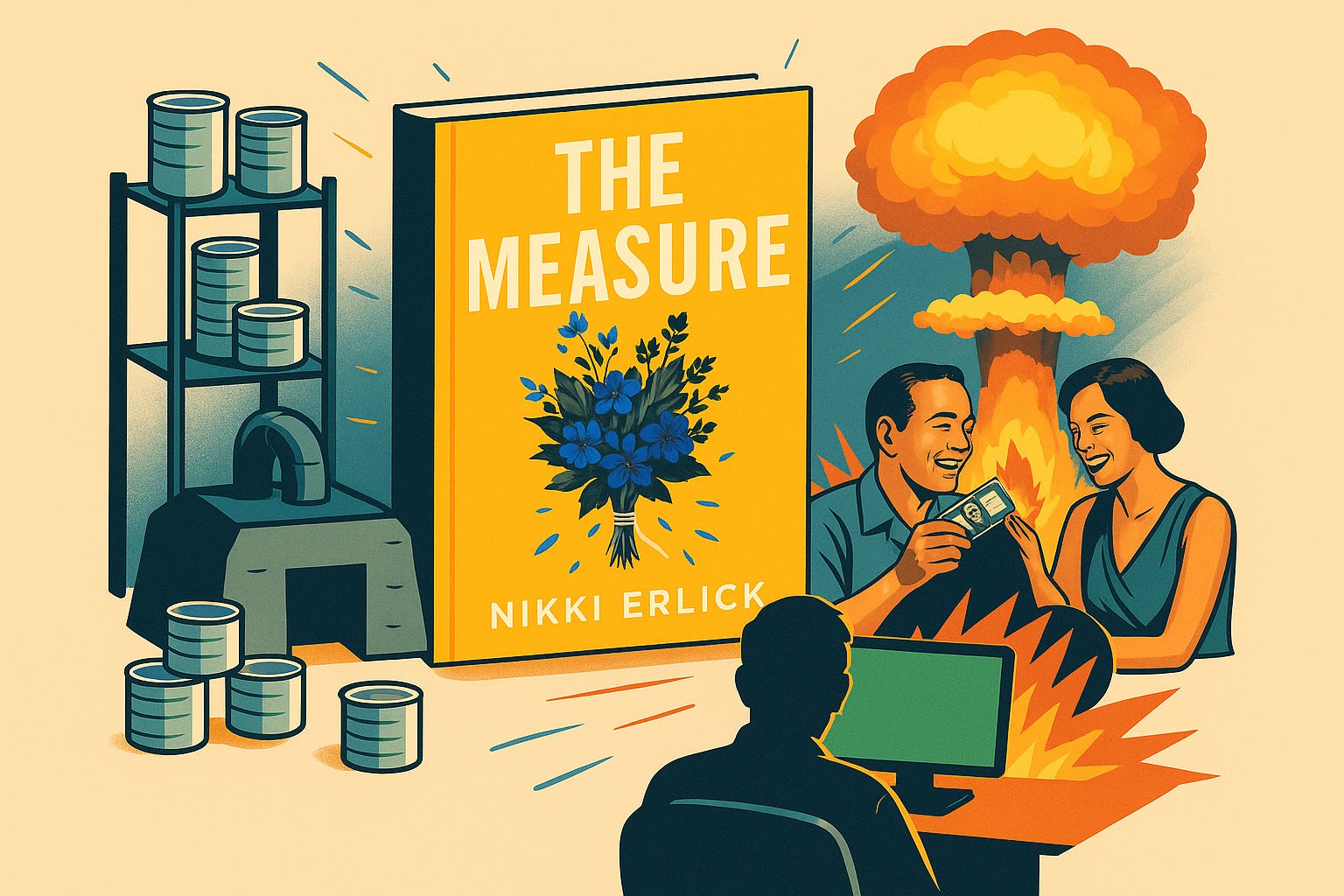
What’s Scarier: Not Knowing or Knowing Too Much?
Tech workers' anxiety about AI is rooted in great uncertainty. Some researchers see the possibility of AI "becoming so powerful that it poses an existential threat to all human life" as serious. Scenarios such as biosecurity/economic collapse are mentioned, and there are those who point out that we will start to see them within 10 years.
The situation in the book is precisely the opposite: the little box left on each doorstep contains the answer to "exactly how many years the owner will live". The threat here is that the future is "too" clear for those who choose to open the box. It seems that we are beings that can be threatened by both uncertainty and certainty.
The Survival Instinct
There are AI preppers building their bio-bunkers, buying land in places they think will be safe, starting resilience counseling, and giving up on having children. There is no "survival preparation" in the book. Rather, the characters' motivations are shaped by making the most of the time they have left. The contrast here is not only between those who do not open the box and those who do, but also between those who do open the box and face the short rope and the long rope.
We’re Doomed Anyway: The Rise of Hedonism
AI preparers stop saving for retirement and even spend their savings because they cannot foresee what will happen a few years from now. New concepts such as "charisma and social interaction will matter more instead of intelligence" (smart-to-hot) come to the fore. In more extreme cases, there are those who prefer extraordinary experiences of pleasure.
Some of the characters in the book who have a short life expectancy may shift to risky experiences by saying "we are going to die anyway". On the contrary, those who know that they have a long life expectancy try extreme experiments because "they won't die anyway". (There are no normal people in the book!)
When Relationships Meet the End of the World
AI preppers are giving up on relationships and committing to AI security. There are even couples who divorce because of different risk approaches. In the book, there are couples with a short and a long rope in a relationship who break up because the one with the short rope tells the one with the long rope that she should spend her life with "someone with a longer rope". Themes of trust/betrayal (opening someone else's box without permission) come to the fore in relationships. Stereotyping and discrimination against "short rope owners" creates social fractures.
What It Means to Be Human
Whether it is the prospect of an apocalypse or the knowledge of a lifespan, such situations force us to rethink our existence, our values, our relationships and our future. AI is not just a technology, it is a tool that drives people to search for the meaning of our lives.
We all react differently, but our journey leads to the same question: Are we seeking to survive or to “truly” live? And perhaps the answer lies not in boxes or bunkers, but in how we connect with each other. Because at the end of the day, even in the face of intelligent machines, the only thing that keeps us going is being human.