

People say AI is the biggest step toward sharing knowledge in history. To get information, you no longer need to be rich, famous, or live in a special place. You just need to ask the right question. Since 2022, millions of people, including us, believe in this promise. Free models, $20 subscriptions, open-source options... AI seemed like a public service, like electricity or water. Sadly, this picture is changing. And it’s changing fast. This change will upset many people.
The DeepSeek Illusion
Do you remember January 2025? DeepSeek shook the market. This Chinese startup said it could match Western competitors with a much smaller budget and an open-source approach. Western companies spent billions of dollars, but DeepSeek’s R1 model cost only about $6 million to train. This was a huge difference compared to similar models from OpenAI or Anthropic. The markets reacted strongly. Nvidia lost hundreds of billions of dollars in one day. People started saying, “AI will get cheaper now.”
But there was a secret. The model was possible because of High-Flyer, a hedge fund that owns DeepSeek. This fund made 56.6% profit in 2025. They didn’t need outside investors because one fund was enough. At least, for that moment.
In April 2026, things changed. DeepSeek’s V4 model was very late. For the first time, the company looked for outside money. They want to collect at least $300 million. The company is now worth $10 billion. So, the person who first said “we can reach the top with cheap and quick ways” is now in the same system: more computing power, more researchers, more money. In short, more money.
Jevons Paradox: How Cheaper Things Become More Expensive
In the 19th century, an economist named William Stanley Jevons noticed something strange. When steam engines became more efficient, people used MORE coal, not less. The paradox is simple: When you use a resource more efficiently, total demand doesn’t go down. It goes up.
AI is living this same paradox now. The cost per token is going down. But nobody uses fewer tokens. It’s the opposite. A simple question uses about 1,000 tokens. But an agent with “thinking” features uses 50,000 tokens for the same task. In the “agent” era, prices per unit go down, but total bills double or triple.
Tokenmaxxing: Silicon Valley’s New Status Symbol
Inside Meta, a secret competition started. An internal leaderboard called “Claudeonomics” tracks the AI token use of 85,000 employees. Top users get titles like “Token Legend” and “Session Immortal.”
In 30 days, total employee use is more than 60.2 trillion tokens. This is truly amazing. The top individual user consumed about 281 billion tokens per day on average. What does this mean? If we use Claude’s normal prices, Meta’s monthly use costs about $900 million.
This isn’t only Meta. Microsoft has had a similar leaderboard since January. Senior engineers, who usually write very little code, are at the top of the list. Top managers spend most of their day in meetings, but they still appear in the top 20. Why? Because token use is becoming a measure of being “AI-native.” People who use less seem behind.
This trend is called “tokenmaxxing.” It turns meaningless use into a status symbol. As Jim Rowan from Deloitte said, this approach assumes token use equals business value. But often, it doesn’t. It’s like counting lines of code in the past.
The real problem is this: This corporate hunger is eating up the world’s computing power. And prices are naturally going up.
Cloud Giants Are Raising Prices
In March 2026, Alibaba Cloud raised prices on many services by 34%. Baidu and Tencent did the same thing soon after. Alibaba said the reason was “rising global AI demand and supply chain costs.”
This is something we haven’t seen in the cloud industry for twenty years. In a market where competition always makes things cheaper, big players raised prices at the same time. This shows that an era is ending. You don’t need to cut prices for market share anymore. Demand is so high that you don’t even need to keep prices low.
The West has the same picture. On April 23, 2026, OpenAI launched GPT-5.5 and did the same thing. They doubled the token price of the GPT-5 series in one step. Input tokens went from $2.50 to $5. Output tokens went from $15 to $30. For people who want to use the top GPT-5.5 Pro, the bill is even heavier: $30 per million input tokens, $180 per million output tokens. Now, top-level reasoning is no longer just a subscription. It’s a question of real wealth.
Anthropic’s Price Experiment
On April 21, 2026, Anthropic quietly updated its prices page. Claude Code was moved from the $20 Pro plan to the $100 Max plan. There was no announcement, no email, no explanation. Reddit, Hacker News, and X exploded immediately. Within a few hours, Anthropic went back. But it’s clear that this plan will become real in the near future.
Amol Avasare, Anthropic’s growth director, explained the situation: “When we launched the Max plan a year ago, there was no Claude Code, no Cowork, and no agents that work for hours. Max was designed for heavy chat use. That’s all.”
Engels’ Pause
We need to see that history is repeating itself here.
In the early years of the Industrial Revolution, production capacity (GDP) grew quickly. But worker wages stayed the same for decades. Steam engines, weaving machines, railways... All these technological jumps happened. But the living standard of normal people only started to improve half a century later. Economists today call this period “Engels’ Pause.” This name comes from Friedrich Engels, who wrote about the dark conditions of workers in that time.
Productivity exploded. But the profits went to the people who owned the machines.
Today, we can see the same risk for AI. AI is doubling the productivity of managers and professionals. Faster analysis, better decision support, stronger tools. But who gets the economic benefit of this productivity? The people who own the models, control the computing power, and have special access to APIs.
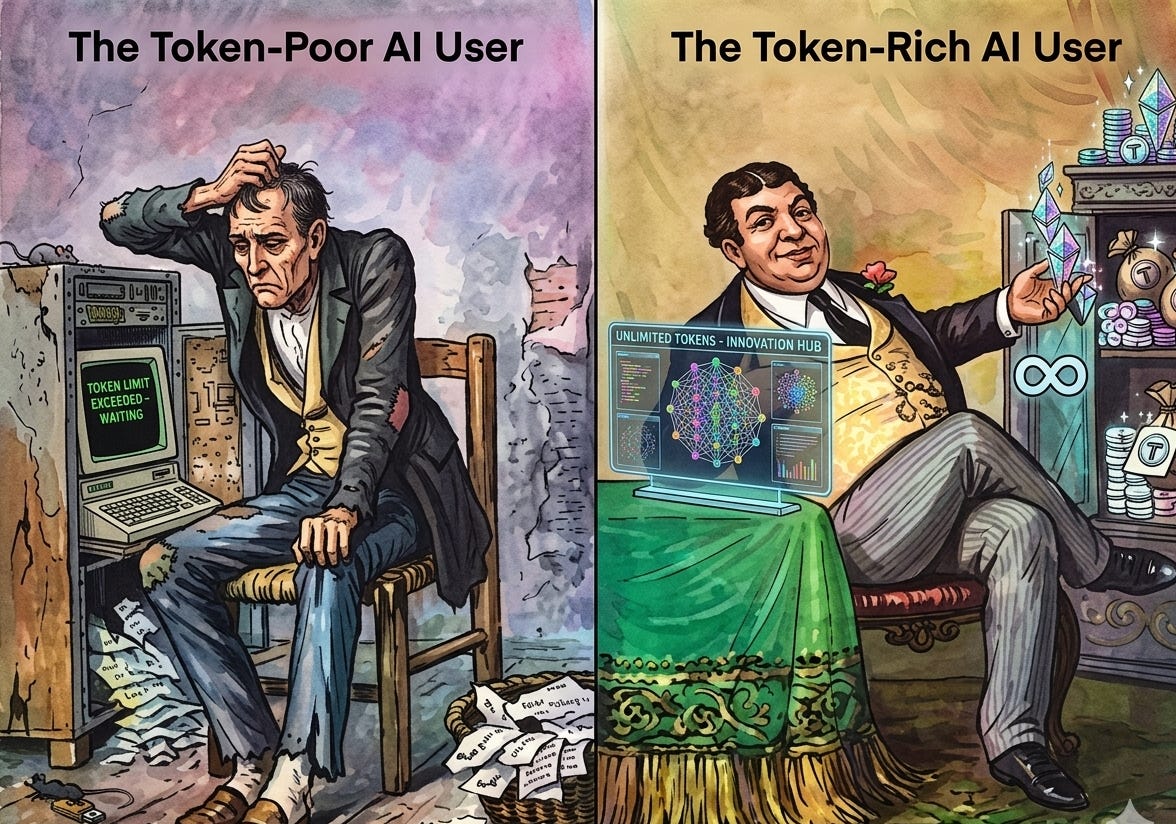
For normal users, the picture is different: Plans are getting smaller. Prices are going up. Top models are becoming a luxury. They promise productivity. But the cost of reaching that productivity grows a little more each month.
In the Industrial Revolution, the pause lasted half a century. We don’t know yet how long the same process will last for AI. But the process has started.
Whose Intelligence?
In the early years of the internet, people promised that access to information would become democratic. This was partly true. But platforms control the algorithms. The attention economy shapes everything.
For AI, the same process is happening much faster and much deeper. The difference is this: This time, it’s not just about access to information. It’s about access to thinking. Access to reasoning, decision support systems, and complex analysis.
And this access is getting more expensive.
Big companies are racing for tokens. Cloud providers are raising prices. Subscription plans are quietly getting smaller. All these things point in one direction: In the near future, access to the most powerful AI tools may become very expensive. What’s left for people who can’t pay? Slower models, smaller contexts, more ordinary answers.
The AI revolution came with a promise to free humanity. But right now, the direction shows something different. Information has never looked so plentiful, so accessible, so cheap. But the power to really buy it may be more limited than ever before.
So, what can we do? Learning the rules of the game will at least make your bill smaller. Which model is enough for which job? How short can a prompt be? A person who knows these things reaches the same result much cheaper. Tokenmaxxing is a status symbol. But token efficiency is a quiet advantage. Open-source models are still there too. Llama, Mistral, Qwen, and others. They keep growing.
But these are individual moves. The process won’t fix itself. Things have always worked this way.