

Two technology giants, Nvidia and Nokia, announced a strategic partnership on October 28, 2025. Nvidia also bought $1 billion worth of Nokia shares. This move made Western countries’ plans for the future of telecommunications clear. We should not see this investment as just a financial operation. It is better to think of it as a new front in trade wars. The goal is to redraw the telecommunications map after 5G and strengthen Western countries against China. Nvidia gave this money to the Finnish company by buying shares. This made Nokia’s share price go up 22%. But the real important point is the goal to win back global leadership in artificial intelligence and 6G technologies.
Huawei’s 5G Dominance
For the West, this move came from necessity. Europe’s love (or dependence) on Huawei, which the European Commission sees as a security threat, forced local giants like Ericsson and Nokia to become smaller. Huawei entered networks by offering very low prices. This weakened EU-based alternatives.
The situation is so serious that even Germany, Europe’s biggest economy, had 57% Huawei equipment in its 4G network in 2019, according to Strand Consult data. This number got even higher in 5G networks, reaching 59%. Across the EU, 15 out of 31 European countries that started 5G services - almost half - depend on Huawei.
In the USA, as you know, China’s two biggest companies in this field, Huawei and ZTE, are banned. So US networks are “clean” according to them. But Huawei’s dominance in the rest of the world has reached levels that kill competition.
A Turkish Signature in 5G: Erdal Arıkan
By the way, we must give credit to a brilliant Turkish mind who laid the foundation of 5G technology: Prof. Dr. Erdal Arıkan. Known as the “Father of Polar Coding,” Arıkan made an extraordinary contribution to the development of communication technologies with his Polar Coding study published in 2008. But it was not Western companies that owned and used this technology in their products - it was Huawei. Prof. Arıkan, who invented Polar Coding that gave them a big competitive advantage in 5G, was honored with a gold medal by Huawei at a grand ceremony in Shenzhen, China in 2018. Huawei CEO Guo Ping called Arıkan “a hero for the communications industry.” Arıkan’s invention not only greatly improves 5G communication performance but also saves energy by reducing coding complexity.
Nokia: Constant Transformation
As we all know, Nokia is famous for early mobile phones. But when it was first founded, it made paper pulp. Later, it did many businesses including rubber. Each time, it transformed its business - or pivoted - into new sectors. We know it from the rise of mobile phones in the 90s. However, with its legendary foresight(!) in consumer products, it had to leave this sector and became a company that produces 5G cellular equipment for telecommunications providers. Actually, it did this work before too, but after leaving consumer products, this area became Nokia’s main business. The 15.6 billion euro Alcatel-Lucent takeover operation in 2016 and the distraction it created caused Nokia’s first 5G offers to not be competitive. Of course, we cannot ignore that Chinese competitors gave incredibly low prices. Result: The global RAN market share, which was 19.5% in 2023, fell to 17.6% last year. Here, Huawei’s market share has passed 34%.
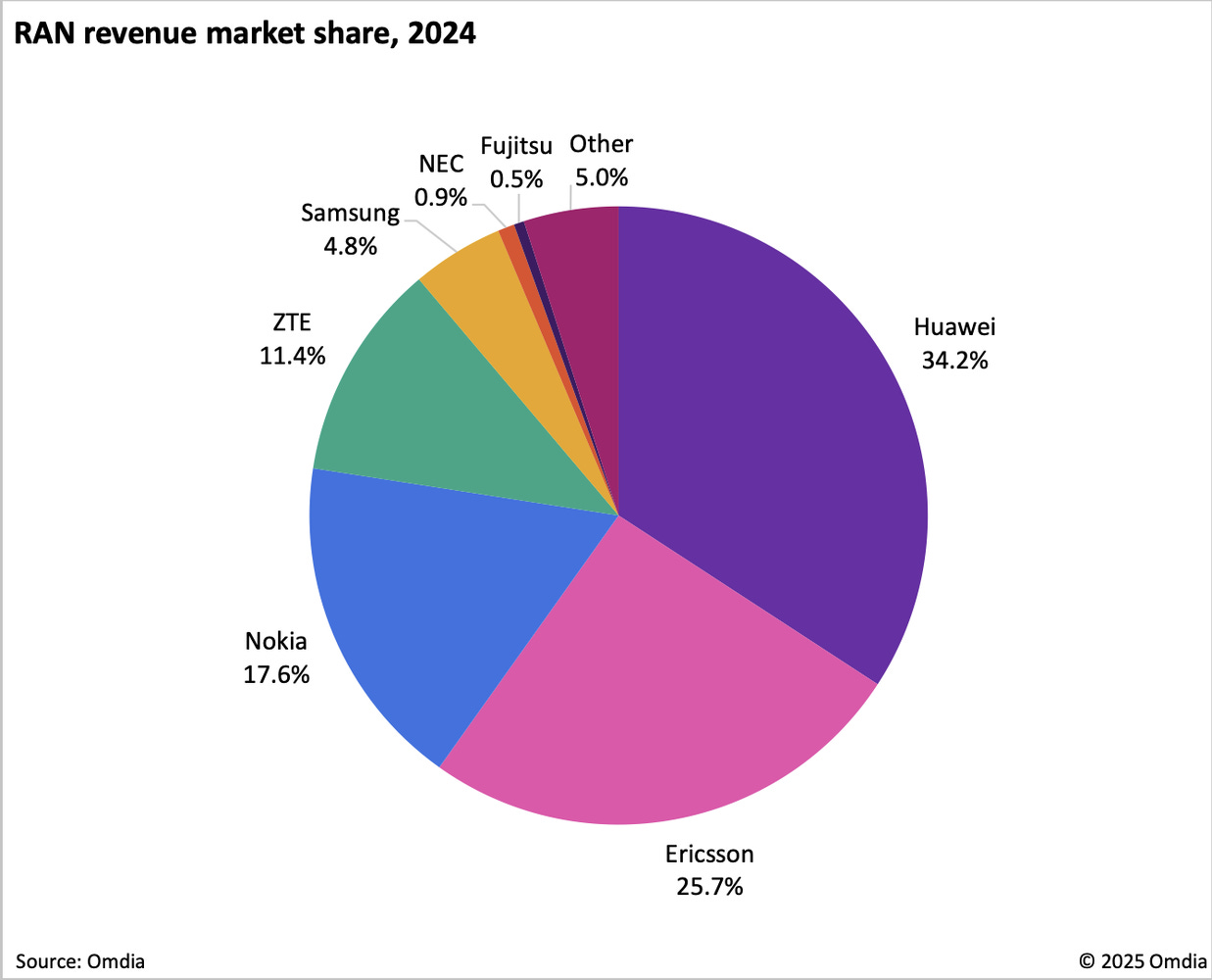
NVIDIA’s $1 billion investment is a vital breath for Nokia to overcome these difficulties in the mobile networks business. Because European operators are not very willing to change (swap-out) Huawei, using costs as an excuse (because they cannot make profit). This investment can increase Nokia’s opportunities to replace Huawei at big customers like Deutsche Telekom by strengthening Nokia’s technological foundation.
6G and Artificial Intelligence
The Nvidia and Nokia partnership directly targets 6G and artificial intelligence integrated radio access networks (AI-RAN). Nvidia CEO Jensen Huang emphasizes that telecommunications is the “critical national infrastructure” of economy and security, and claims that AI-RAN will revolutionize this sector. Nokia CEO Justin Hotard summarizes the purpose of this partnership as “putting an AI data center in everyone’s pocket.”
In this transition to the new era, Nvidia introduced the Aerial RAN Computer Pro (ARC-Pro), an accelerated computing platform ready for 6G. Nokia will carry its 5G and 6G software on Nvidia’s CUDA platform and will place ARC-Pro at the heart of the new AI-RAN solution. This will offer a chance to be an important player in the fast-growing AI-RAN market, which is expected to exceed $200 billion cumulatively by 2030. Operators like T-Mobile will also start testing AI-RAN technologies for 6G in 2026.
Producer Diversity and Turkey’s Role
Europe’s dangerous dependence on Huawei is not only a political risk but also suffocates competition and innovation in the market. It is hard to say that the two Nordic companies (Nokia and Ericsson) can keep up with Huawei’s exhausting pricing policies. That’s why there is a clear Chinese dominance in Africa and Latin America. However, even Samsung’s emergence from South Korea could not eliminate this monopolization risk.
In conclusion, we need more players and more innovation in the telecom equipment market. Depending on a single “high-risk” supplier like Huawei is playing a terrible gamble for our national security and economic future, like all countries. I wrote about local producers before. These companies taking an active role in the 5G-Advanced and 6G transition is critically important not only economically but also in terms of digital independence. Increasing competition in the market is the most guaranteed way to strengthen technological resilience; otherwise, we will have handed over our digital future to others.
See you in the next article.
Hey, great read as always. This realy drives home the strategic imperative for Europe in the AI and 6G race. I do wonder if these efforts to 'redraw the map' will ultimately foster more genuine collaboration or just lead to a more divided global tech landscape.